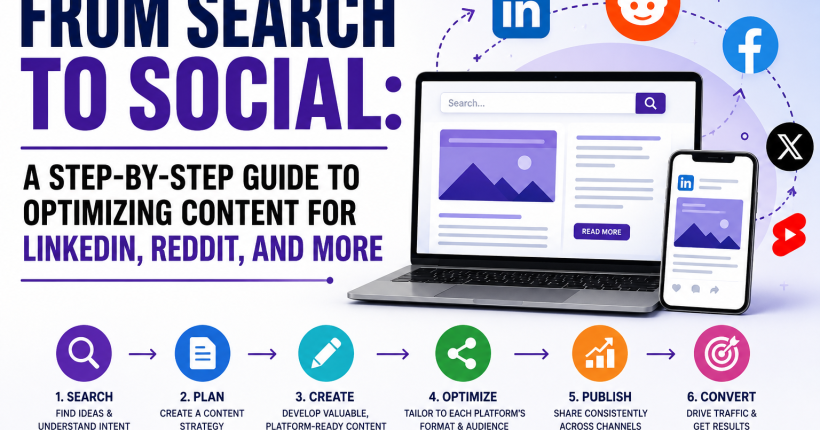
In digital marketing, creating content without proper research is like navigating a city without a map. You might reach your destination, but you will probably waste time, effort, and resources along the way. Successful digital marketers understand that effective content creation begins long before writing a blog, designing a social media post, or recording a video. It starts with research.
Content research for digital marketing helps businesses understand their target audience, identify relevant topics, discover valuable keywords, analyse competitors, and create content that meets users’ needs. Whether you are a beginner learning SEO, a content writer developing your skills, or a business owner trying to improve website traffic, content research can help you make informed marketing decisions.
In this complete guide, you will learn how content research works, why it matters, which tools you can use, and how to develop a practical content research process that supports your digital marketing goals.
What Is Content Research in Digital Marketing?
Content research is the process of collecting, analysing, and interpreting information to identify the topics, questions, keywords, and content formats that are most relevant to a target audience.
In digital marketing, content research helps marketers determine what their audience wants to learn, what information competitors are publishing, and what opportunities exist to create more useful content.
For example, imagine you are promoting an advanced digital marketing course. Instead of randomly publishing articles about SEO, Google Ads, and social media marketing, you conduct research to understand what potential students are searching for.
Your research might reveal questions such as:
- How can beginners learn digital marketing?
- Which digital marketing skills are in demand?
- How can I prepare for a digital marketing interview?
- Which AI tools are useful for digital marketers?
- How long does it take to learn SEO?
These questions can become blog topics, YouTube videos, social media posts, email newsletters, and downloadable learning resources.
Therefore, content research is not simply about finding topics. It is about discovering opportunities to connect your content with the needs, interests, and search behaviour of your audience.
Why Is Content Research Important for Digital Marketing?
A well-researched content strategy can improve the effectiveness of your marketing campaigns and help you use your resources more efficiently.
1. Helps You Understand Your Target Audience
Every successful marketing campaign begins with an understanding of the audience. Content research helps you identify your audience’s interests, challenges, preferences, and questions.
For example, students interested in digital marketing may want practical training, interview preparation, portfolio-building guidance, and information about career opportunities.
Understanding these needs allows you to create relevant content instead of publishing articles based entirely on personal assumptions.
2. Improves SEO Performance
Search engine optimisation depends on understanding what people search for and creating useful content that satisfies their needs.
SEO content research helps identify relevant keywords, search intent, competing pages, and opportunities to improve existing content.
When your content answers users’ questions clearly and comprehensively, it has a better chance of becoming useful to readers and earning visibility in search results. However, rankings also depend on factors such as competition, website quality, technical SEO, and relevance.
3. Reduces Content Creation Waste
Creating content requires time, effort, and sometimes significant financial investment.
Without research, you might spend hours writing an article that attracts little interest from your intended audience.
Content research helps you prioritise topics based on audience relevance, business objectives, search demand, and the resources available to you.
4. Helps You Discover Competitor Opportunities
Your competitors may already be attracting visitors through blogs, videos, and social media content.
Competitor content analysis helps you understand which subjects they cover, how they organise their content, and which important questions remain unanswered.
You can use these findings to create more useful, original, and detailed resources.
5. Supports Lead Generation and Conversions
Content should do more than attract visitors. It should help people move towards an appropriate next step.
For example, someone searching for basic SEO definitions may be at the awareness stage, while someone comparing digital marketing courses may be closer to making an enrolment decision.
Research helps you create content for different stages of the customer journey, allowing you to guide potential customers from learning about a subject to evaluating your offering.
The Complete Content Research Process: Step by Step
An organised content research process makes it easier to turn scattered ideas into a practical content plan.
Follow these eight steps to get started.
Step 1: Define Your Content Goals
Before researching keywords or analysing competitors, establish what you want your content to achieve.
Your objectives might include:
- Increasing organic website traffic.
- Improving search engine rankings.
- Generating qualified leads.
- Building brand awareness.
- Growing social media engagement.
- Promoting a digital marketing course.
- Establishing authority in a specific industry.
Your goals influence the type of research you conduct.
For example, if your objective is to generate course enquiries, researching course comparison queries, career-related questions, and interview preparation topics may be more useful than focusing exclusively on general marketing definitions.
Set measurable objectives wherever possible. You could track organic clicks, enquiries, newsletter subscriptions, or course demo bookings.
Step 2: Conduct Audience Research for Content Creation
The next step is understanding who you are creating content for.
Audience research for content creation involves identifying the characteristics, motivations, problems, and information needs of your potential readers.
Consider the following questions:
- Who is your ideal reader?
- What problems are they trying to solve?
- What knowledge do they already have?
- What questions do they frequently ask?
- Which platforms do they use to discover information?
- What prevents them from achieving their goals?
You can collect information from customer interviews, student feedback, sales conversations, website analytics, social media comments, online communities, and frequently asked questions.
For example, if you are targeting students who want to enter digital marketing, you may discover that they struggle with practical SEO implementation, interview confidence, and choosing the right tools.
These findings can inspire topics such as How to Build an SEO Portfolio Without Work Experience or 15 Digital Marketing Interview Questions Every Beginner Should Prepare For.
The objective is to base your content decisions on genuine audience needs rather than assumptions.
Step 3: Perform Keyword Research for Content Marketing
Keyword research for content marketing helps you identify the search terms people use when looking for information, products, and services.
Start by listing broad topics related to your business. If you promote digital marketing training, these might include SEO, social media marketing, content writing, Google Ads, email marketing, and AI tools.
Next, expand each topic into specific search queries.
For example:
| Broad Topic | Related Keyword | Long-Tail Keyword |
|---|---|---|
| SEO | SEO training | How to learn SEO from scratch |
| Content Marketing | Content strategy | How to create a content marketing strategy |
| Google Ads | Google Ads course | How to prepare for a Google Ads interview |
| Social Media | Social media marketing | Social media marketing strategies for beginners |
| AI Tools | AI marketing tools | Best AI tools for digital marketing students |
Use keyword research tools to investigate search volume, competition, related queries, and keyword variations.
However, do not select keywords based on search volume alone. Consider relevance, search intent, ranking difficulty, and the value a visitor could bring to your business.
A keyword with modest search demand may still be valuable if it attracts highly relevant visitors.
Step 4: Understand Search Intent
Search intent refers to the reason behind a person’s search query.
Understanding search intent is an essential part of SEO content research because it helps you determine what type of content is most appropriate for a particular keyword.
The four commonly used categories are:
Informational intent: The user wants to learn something.
Example: What is content marketing?
Suitable content: Educational blogs, tutorials, and explanatory videos.
Navigational intent: The user wants to find a specific website or page.
Example: Google Search Console login.
Suitable content: The official destination or relevant website page.
Commercial investigation: The user is comparing options before making a decision.
Example: Best digital marketing courses for beginners.
Suitable content: Comparison articles, detailed reviews, and course evaluation guides.
Transactional intent: The user is ready to take an action.
Example: Enrol in a digital marketing course in Kolkata.
Suitable content: Course landing pages, enrolment pages, and relevant offers.
To understand intent, examine the search results for your target keyword. Look at the types of pages ranking, the questions they answer, and the information users appear to expect.
Your content should satisfy the dominant intent rather than forcing an unsuitable format onto the topic.
Step 5: Conduct Competitor Content Analysis
Competitor content analysis helps you understand how other websites approach topics relevant to your audience.
Begin by searching for your target keywords and identifying websites that consistently appear in the results.
Study their content to understand:
- Which topics they cover.
- How they structure their articles.
- Which questions they answer.
- What examples and resources they provide.
- Whether their content appears current.
- Which related subjects they explore.
- Where their explanations are incomplete or unclear.
You can also examine competing YouTube videos, social media posts, and downloadable resources when researching content for those platforms.
For example, suppose several competing articles explain keyword research but provide no practical example. You could create a more useful guide that demonstrates how to identify keywords, evaluate search intent, organise them into topic clusters, and build a content calendar.
The goal is not to copy competitors. It is to understand the existing information landscape and identify ways to serve your audience better.
Step 6: Perform Content Gap Analysis
Content gap analysis identifies important topics or questions that your existing content does not adequately address.
It can help you discover opportunities for new articles and improvements to existing pages.
For example, a digital marketing training website might already have articles about SEO, social media marketing, and Google Ads.
However, it may lack content covering:
- Digital marketing interview preparation.
- Time management for marketing students.
- Content research methods.
- AI tools for practical marketing projects.
- Building a digital marketing portfolio.
- Measuring campaign performance.
These gaps could represent opportunities to expand the website’s topical coverage.
You can also compare your existing articles with competing pages to identify missing explanations, examples, and related questions.
Prioritise gaps according to audience relevance, business goals, and your ability to create genuinely useful content.
Step 7: Explore Content Research Tools
The right content research tools can save time, organise information, and help you make better decisions.
Here are some useful options for digital marketers.
1. Google Trends
Google Trends helps you explore interest in search topics over time and compare related terms. It is particularly useful for identifying seasonal patterns and evaluating emerging topics.
2. Google Search Console
Google Search Console provides information about your website’s search performance, including queries, clicks, impressions, and average search position. Use this data to identify existing pages that could benefit from better targeting or additional content.
3. Google Keyword Planner
Google Keyword Planner helps you discover keyword ideas and review estimated search activity. It is particularly useful when planning search advertising campaigns, although its estimates should be interpreted carefully for organic SEO decisions.
4. Semrush
Semrush offers keyword research and competitive analysis features that can help you explore search opportunities, competing websites, and content performance.
5. Ahrefs
Ahrefs provides SEO research features for analysing keywords, backlinks, competing pages, and potential content opportunities.
6. AnswerThePublic
AnswerThePublic organises search-related questions and phrases around topics, helping marketers discover possible article ideas and audience questions.
7. Google Search
A simple Google search remains valuable for examining search intent, related questions, competing articles, and the formats appearing in search results.
8. ChatGPT
ChatGPT can help you brainstorm topic ideas, organise research notes, develop audience personas, generate initial keyword variations, and create content outlines.
Always verify AI-generated suggestions against reliable sources and actual audience or search data. AI-generated keyword ideas are not proof of search volume or ranking potential.
You do not need every tool. Start with a small collection that suits your budget and objectives.
Step 8: Organise Your Research into a Content Strategy
Research becomes valuable when you turn your findings into an actionable content strategy for digital marketing.
Create a spreadsheet containing the following information:
| Research Field | Purpose |
|---|---|
| Topic | Identifies the subject to cover |
| Primary keyword | Defines the main search target |
| Secondary keywords | Adds relevant subtopics |
| Search intent | Clarifies the reader’s objective |
| Target audience | Identifies the intended reader |
| Content format | Specifies blog, video, carousel, or another format |
| Competitor observations | Records useful findings from competing content |
| Content gap | Highlights missing information or opportunities |
| Priority | Helps determine publishing order |
| Call to action | Defines the desired next step |
Next, group related topics into content clusters.
For example, a central pillar page about SEO could link to supporting articles about keyword research, on-page SEO, technical SEO, backlink strategies, SEO audits, and performance measurement.
This structure can help readers explore related subjects and help search engines understand the relationships between your pages.
Finally, use a content calendar to schedule research, writing, editing, publishing, and performance reviews.
How to Turn Content Research into Better Blog Posts
After completing your research, follow a repeatable workflow to create useful articles.
First, choose a focused topic. Select a subject that matches your audience’s needs and your business objectives.
Second, identify the primary keyword. Choose a relevant search query that accurately reflects the article’s purpose.
Third, review related keywords. Identify useful subtopics, questions, and related concepts to include naturally.
Fourth, examine competing content. Understand what readers can already find and identify opportunities to provide additional value.
Fifth, prepare a logical outline. Organise the article into headings that answer the reader’s questions in a sensible order.
Sixth, gather reliable information. Consult authoritative sources, original research, practical examples, and relevant data. Verify important factual claims before publication.
Seventh, write for people first. Explain concepts clearly, use examples, and avoid unnecessary repetition.
Finally, review and optimise. Check factual accuracy, readability, internal links, metadata, heading structure, and the overall usefulness of the article.
Remember that keyword inclusion alone does not guarantee rankings. The content must fulfil the reader’s needs and provide a satisfactory experience.
Common Content Research Mistakes to Avoid
Even experienced marketers can make mistakes that weaken their research and content strategy.
Choosing Keywords Without Considering Intent
A keyword may appear attractive because of its search volume, but the content may fail if it does not match what users expect.
Always investigate the search results and understand the purpose behind the query.
Copying Competitors
Competitor research should inform your decisions, not become a shortcut for reproducing someone else’s work.
Develop original explanations, examples, perspectives, and research wherever possible.
Ignoring the Target Audience
A technically accurate article can still perform poorly if it does not address the reader’s actual concerns.
Use audience feedback and real search queries to keep your content relevant.
Overusing Keywords
Repeatedly inserting the same phrase can make an article difficult to read.
Use your primary keyword where appropriate and include related terminology naturally. Prioritise clarity over arbitrary keyword density targets.
Publishing Without Measuring Results
Content research should not end when an article goes live.
Monitor relevant metrics, review user behaviour, and update articles when information becomes outdated or new opportunities emerge.
How to Measure the Effectiveness of Your Content Research
You need suitable performance indicators to determine whether your research is supporting your marketing objectives.
For organic search, use Google Search Console to monitor impressions, clicks, click-through rate, and search position.
For website engagement, use an analytics platform to examine relevant engagement indicators and the actions visitors take after reading your content.
For lead generation, track enquiries, form submissions, newsletter registrations, and course demo bookings.
For social media content, measure relevant indicators such as reach, saves, shares, comments, and link clicks.
Evaluate these metrics against your original goals.
For example, if an article attracts substantial organic traffic but generates few course enquiries, you could review its audience relevance, calls to action, internal links, and connection to your course offering.
Avoid judging an article solely by its initial performance. Some topics take time to attract search visibility, while others may generate value through social media, email marketing, or direct visits.
Conclusion
Content research is one of the most important foundations of effective digital marketing. It helps you understand your audience, discover valuable keywords, analyse competitors, identify content gaps, and develop a strategy based on evidence rather than guesswork.
By following a structured content research process, you can create more relevant blog posts, improve your SEO efforts, plan social media campaigns, and develop resources that support your business goals.
Start with your audience, research the questions they ask, evaluate search intent, and organise your findings into a practical content calendar. Use tools to support your decisions, but always apply your judgement and verify important information.
If you are planning to build a career in digital marketing, learning content research is an essential step towards mastering SEO, content marketing, and data-driven campaign planning.
Want to develop practical digital marketing skills? Explore a structured digital marketing course that helps you apply keyword research, content planning, SEO, analytics, and AI tools to real-world marketing projects.
1. What is content research in digital marketing?
Content research in digital marketing is the process of identifying audience needs, relevant topics, keywords, search intent, and competitor opportunities to plan useful and effective marketing content.
2. Which tools are best for content research?
Useful tools include Google Trends, Google Search Console, Google Keyword Planner, Semrush, Ahrefs, AnswerThePublic, Google Search, and ChatGPT. The best combination depends on your objectives, budget, and research requirements.
3. How does content research improve SEO?
Content research helps you identify relevant search queries, understand user intent, discover content gaps, and create pages that address users’ needs. These activities can support SEO performance, although rankings also depend on competition, technical factors, website quality, and other signals.
4. What is the difference between keyword research and content research?
Keyword research focuses primarily on identifying and evaluating search terms. Content research is broader and also includes audience analysis, competitor research, search intent, topic discovery, information verification, and content planning. Keyword research is an important component of the overall content research process.
5. How often should digital marketers conduct content research?
Conduct initial research before creating a content strategy and revisit it regularly. Review search performance, competitor activity, audience feedback, and emerging topics monthly or quarterly, depending on your industry and publishing frequency. Update individual articles whenever significant changes make their information outdated.

Sourav Karmakar is an MBA from symbiosis University with 8 plus years of experience in Digital Marketing as a Mentor , Trainer , and content ceator in various platforms helping aspiring creators