
Table of Contents
Introduction
Content optimization for social media is no longer about copying a blog post and publishing the same text everywhere. Each platform has its own audience behavior, content format, vocabulary, algorithm signals, and expectations.
A detailed article that performs well in Google may need to become a short LinkedIn insight, a practical Reddit discussion, a quick Facebook post, or a visually driven YouTube Short.
The problem is simple: one piece of content can have multiple entry points, but each entry point requires a different presentation.
A successful search-to-social strategy therefore asks:
- What does the user want at this stage?
- Which platform are they using?
- What format does that platform reward?
- How much information should be shared before asking for a click?
- What action should the user take next?
The goal isn’t to create completely different content for every channel. Instead, you can repurpose the core idea while optimizing its format, language, and purpose for each platform.
The first step in content optimization for social media is understanding where your audience is entering your content journey.
Someone arriving from Google may have a specific problem and actively want an answer. A LinkedIn user may be browsing for professional insights, while a Reddit user may be looking for real experiences from people who have already solved the problem.
That means the same topic should not necessarily receive the same treatment everywhere.
Match the content to the user’s mindset
Consider these entry points:
- Google: The user is actively searching for information or a solution.
- LinkedIn: The user may be interested in professional knowledge, trends, or business lessons.
- Reddit: The user may want genuine experiences, opinions, comparisons, or practical solutions.
- Facebook: The user may be browsing socially and respond better to concise, accessible content.
- YouTube Shorts: The user expects an immediate visual or informational payoff.
- X or Bluesky: The user often expects concise observations, opinions, commentary, or fast-moving information.
Before publishing, identify the user’s stage:
- Problem awareness – They know something is wrong.
- Research – They are looking for possible solutions.
- Comparison – They are evaluating different options.
- Decision – They are close to taking action.
- Purchase/action – They need a clear next step.
This prevents a common mistake: sending every social media user directly to a sales page when they aren’t ready to buy.
Example: Suppose your website has an article titled “How to Reduce Google Ads Costs.”
Instead of posting the entire article everywhere:
- LinkedIn could focus on three mistakes increasing CPC.
- Reddit could discuss an actual campaign-testing process.
- YouTube Shorts could demonstrate one quick optimization.
- Your website could contain the comprehensive guide and conversion-focused CTA.
The core information remains connected, but the presentation changes according to intent.
A major part of content optimization for social media is understanding that every platform has different expectations for length, structure, and readability.
A long-form article might need headings, paragraphs, examples, and detailed explanations. A social post may need a strong opening sentence followed by a few short points.
Some platforms, including X and Bluesky, also have post-length limitations or different limits depending on account features and subscription options. Therefore, always check the platform’s current publishing limits before preparing a campaign.
Adapt rather than simply shorten
Don’t take a 2,000-word article and randomly cut it down to 200 words.
Instead, identify the most useful idea for each platform.
For example:
Original article:
“10 Ways to Improve Your LinkedIn Lead Generation Strategy.”
LinkedIn version:
Your LinkedIn posts aren’t generating leads because you’re optimizing for impressions instead of intent.
Start with these three changes:
- Solve one specific problem.
- Show evidence or an example.
- Give readers one clear next step.
Reddit version:
Start a discussion around a specific problem:
“What actually helped you generate your first consistent LinkedIn leads? I tested several approaches and found that…”
Then provide practical context and invite genuine discussion.
YouTube Short:
Turn one insight into a 30–60 second visual explanation.
The lesson is simple: don’t optimize only for word count. Optimize for how people consume information on that platform.
Formatting matters too
Use:
- Short paragraphs
- Clear spacing
- Lists where appropriate
- Strong opening hooks
- Platform-native formatting
- Relevant examples
- One primary CTA
The easier your content is to scan, the easier it is for users to understand its value.
Effective content optimization for social media also requires adapting vocabulary.
Different audiences don’t necessarily describe the same problem in the same way.
A marketer might search for “conversion rate optimization,” while a small business owner may say, “Why aren’t people buying from my website?”
The second phrase may be more natural for a social conversation.
Learn the language of each community
When adapting content:
- Identify commonly used terms.
- Read comments and discussions.
- Look at questions people repeatedly ask.
- Avoid unnecessary industry jargon.
- Use terminology that matches the audience’s experience level.
- Pay attention to the difference between professional and conversational language.
Reddit is especially important here. Many communities value authentic human experiences rather than polished promotional language.
A post that sounds like an advertisement may immediately lose credibility.
Example: Product comparison
Imagine you’re creating content about two email marketing platforms.
A website comparison page might use a structured format:
| Feature | Platform A | Platform B |
|---|---|---|
| Pricing | … | … |
| Automation | … | … |
| Templates | … | … |
A Reddit discussion could instead focus on the actual user experience:
- Which platform is easier for beginners?
- Which has better automation?
- What problems appeared after six months?
- Which one is better for a small team?
For comparison content, fairness matters.
If you are affiliated with one of the products you’re reviewing, disclose that relationship clearly. Transparency helps protect credibility and gives readers the information they need to evaluate your recommendation.
An unbiased comparison can also become valuable search content because it directly addresses the questions people use when researching products and services.
Algorithms influence what users see, but the solution isn’t to write content solely for an algorithm.
Think of your content as input data that algorithms evaluate alongside user behavior.
Signals can include factors such as:
- Engagement
- Watch time
- Clicks
- Comments
- Shares
- Saves
- Relevance
- User interactions
- Content quality
- Topic consistency
This is why misleading headlines or descriptions can hurt your strategy. If your content promises one thing and delivers another, users may leave quickly or fail to engage.
Make descriptions accurately represent the content
Descriptions are particularly important for discoverability.
A good description should:
- Clearly explain what the content is about.
- Include relevant terminology naturally.
- Give users a reason to continue.
- Match the actual content.
- Avoid keyword stuffing.
- Support the intended action.
For videos, the visual experience is often more important than the written description, particularly with short-form content.
Example: YouTube Short
Suppose your Short is titled:
“3 Google Ads Mistakes That Waste Your Budget”
The first few seconds should immediately communicate the promise visually and verbally.
Don’t spend the opening five seconds saying:
“Hi everyone, welcome back to my channel…”
Instead:
“Your Google Ads campaign may be wasting money because of these three settings.”
Then reveal the three mistakes quickly.
The description can reinforce the topic, but it cannot compensate for a weak video.
Problem → insight → proof/example → action is often a stronger structure than a long introduction.
The final stage of content optimization for social media is connecting social engagement with your website.
Social media content shouldn’t always attempt to sell immediately. Its job may simply be to create awareness, build trust, answer a question, or move someone into the next stage of the journey.
Your website, however, should be prepared for visitors who are further along.
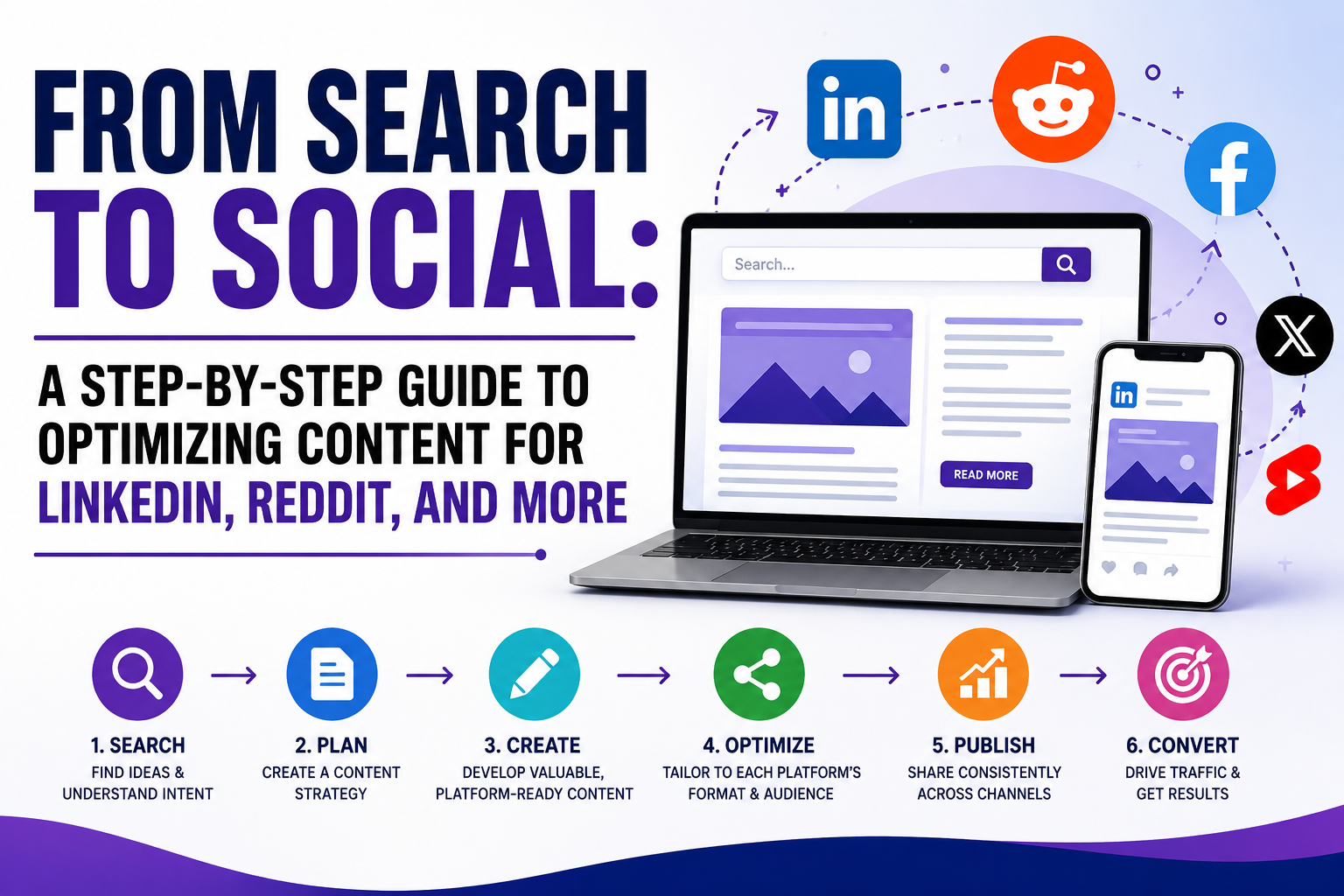
A practical flow looks like this:
Search article → Social snippet → Social engagement → Website visit → Conversion-focused page → Action
For example:
Step 1: Search content
Publish a comprehensive article:
“How to Choose the Right Google Ads Agency for Your Business.”
Step 2: LinkedIn
Share three warning signs that a business should look for before hiring an agency.
Step 3: Reddit
Participate in relevant discussions about agency pricing, reporting, contracts, and campaign management. Provide useful information instead of immediately promoting your service.
Step 4: Website
Direct interested users to a detailed resource or service page.
Step 5: Conversion
Give qualified visitors a clear next step:
- Book a consultation
- Request an audit
- Download a guide
- Contact the agency
- View case studies
This creates a better relationship between content and conversion.
Match the CTA to the user’s intent
Avoid using the same CTA everywhere.
For example:
Awareness:
“Follow for more practical Google Ads tips.”
Research:
“Read the complete guide.”
Comparison:
“See the full comparison.”
Decision:
“Request a campaign audit.”
Purchase:
“Book a consultation.”
The closer the user is to making a decision, the more direct your CTA can become.
Conclusion
Successful content optimization for social media isn’t about publishing the same content on every platform. It’s about taking one valuable idea and adapting it to the expectations, language, format, algorithmic environment, and intent of each audience.
LinkedIn may reward professional insights and useful takeaways. Reddit can work better when content demonstrates genuine experience and practical value. Facebook may require a simpler, more direct approach. YouTube Shorts depend heavily on immediate visual communication, while search content can provide the detailed information users need before making a decision.
The most effective approach is therefore:
- Start with the user’s problem.
- Identify the platform and intent.
- Adapt the content format.
- Use platform-specific language.
- Create accurate and useful descriptions.
- Provide genuine value before asking for action.
- Connect social content to relevant website pages.
- Match the CTA to the user’s buying journey.
- Disclose affiliations when reviewing products or brands.
- Measure engagement and improve your approach over time.
Think of your website as the knowledge hub and social platforms as different distribution and discovery environments.
When you optimize the same core idea for each environment instead of simply copying and pasting it, your content can move more effectively from search to social—and from social engagement to meaningful website conversions.

Sourav Karmakar is an MBA from symbiosis University with 8 plus years of experience in Digital Marketing as a Mentor , Trainer , and content ceator in various platforms helping aspiring creators